
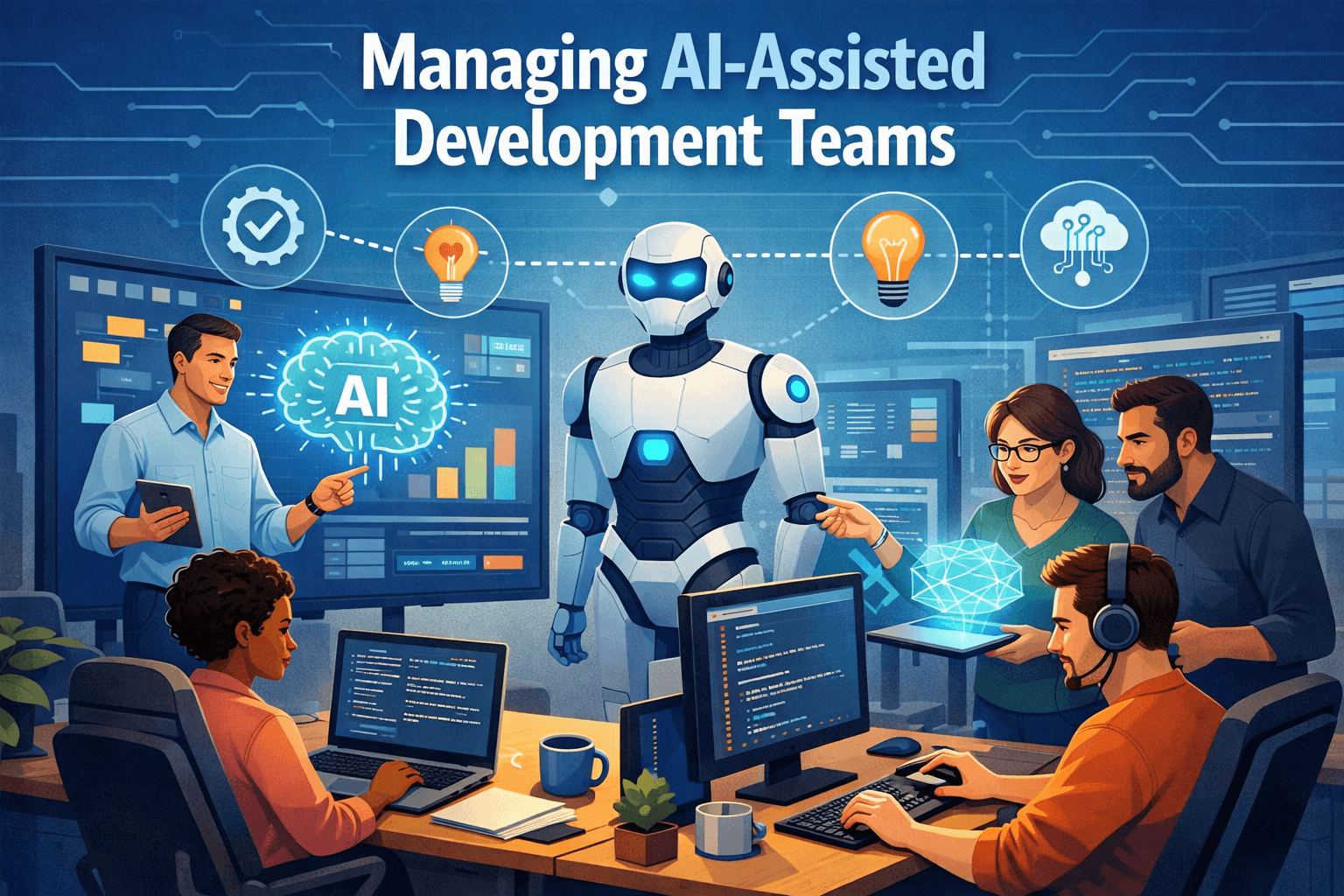
The New Engineering Leadership: How to Manage AI-Assisted Development Teams
Not long ago, engineering leadership was primarily about managing human dynamics, technical debt, and sprint velocities. Today, a new entity has entered the daily standup: the AI assistant.
With tools like GitHub Copilot, Cursor, and custom LLM pipelines integrated into the developer workflow, the nature of software engineering has fundamentally shifted. Developers aren't just writing code anymore; they are reviewing, steering, and auditing code generated by AI.
As a manager, this means your playbook needs an upgrade. Managing an AI-assisted development team requires balancing unprecedented speed with new risks. Here is how to navigate this new frontier.
1. Redefine Your Team’s Core Competencies
When AI can generate a boilerplate API endpoint in three seconds, "syntax proficiency" ceases to be a differentiator for top-tier talent. The skill set of a great developer is evolving from writing code to system design and critical review.
From Coders to Editors
Your engineers now need to act like senior editors. They must possess the system-level understanding to question the AI’s output.
-
The Risk: "Code blindness"—where developers blindly accept tab-completions without understanding the underlying logic.
-
The Solution: Upskill your team in architectural design, security best practices, and advanced debugging. Reward developers who catch subtle AI hallucinations or optimization flaws during code reviews.
2. Shift Metrics from "Outputs" to "Outcomes"
If you are still measuring developer productivity by lines of code (LOC) or pull request (PR) volume, it is time to stop. AI can artificially inflate these metrics overnight.
Instead, shift your focus to business outcomes and software quality.
| Old Metric | The AI-Era Counterpart | Why It Matters |
| Lines of Code (LOC) | Feature Delivery Velocity | Measuring how fast stable value reaches the user. |
| PR Count | Change Failure Rate | Tracking how often new code breaks existing systems. |
| Time to Code | Time to Architecture/Design | Shifting focus to upfront planning rather than typing. |
Focus on metrics like Cycle Time (how fast an idea goes to production) and Defect Density. If your team is delivering twice as many PRs but production outages have spiked, the AI isn't helping—it's just generating technical debt faster.
3. Establish Clear AI Governance and Guardrails
As a manager, you are the gatekeeper of your company’s intellectual property and security. Deploying AI tools without guardrails is a recipe for compliance disasters.
-
Intellectual Property & Licensing: Ensure your team is using enterprise-grade AI tools that guarantee your proprietary code isn't being used to train public models. Be aware of code snippet attribution to avoid licensing violations (e.g., GPL code leaking into commercial products).
-
Security Scanning: AI is notorious for writing functional code that contains subtle security vulnerabilities (like SQL injections or hardcoded keys). Implement mandatory, automated Static Application Security Testing (SAST) in your CI/CD pipeline to catch these before human review even begins.
4. Don't Let Junior Developers Fall Behind
AI tools are a massive boon for senior engineers who already know what good architecture looks like. They can use AI to bypass the mundane typing and focus on high-level design.
For junior developers, however, AI can be a double-edged sword. If a junior dev relies on AI to solve every bug, they miss out on the "productive struggle" that builds deep engineering intuition.
Guarding the Junior Growth Path
-
Encourage "Sandbox" Coding: Have juniors write code without AI assistance for the first few months on a new framework to build muscle memory.
-
Pair Programming (Human to Human): Do not let AI replace human mentorship. Pair senior engineers with juniors specifically to discuss why an AI-suggested solution is good or bad.
-
Prompt Engineering Mentorship: Teach juniors how to prompt AI for explanations, not just code. For example, instead of asking "Write this function," teach them to ask, "Explain the pros and cons of three different ways to structure this function."
5. Foster an "Automation-First" Culture
The most successful AI-assisted teams are those that don't just use AI for auto-complete, but integrate it into their broader workflows. Encourage your team to experiment with AI for:
-
Generating comprehensive unit tests and edge cases.
-
Documenting legacy codebases.
-
Refactoring monolithic functions into microservices.
Create a safe environment for experimentation. Dedicate a portion of your sprint to "AI R&D," where developers can share custom prompts, GPT agents, or workflows that saved them time.
Conclusion: The Manager as an Orchestrator
Managing an AI-assisted team isn’t about monitoring keystrokes or fearing that robots will replace your devs. It’s about orchestration. Your role is to remove friction, set the ethical and technical boundaries, and ensure your team uses these hyper-tools to build more resilient, impactful software.
The future belongs not to the AI alone, nor to the traditional developer—it belongs to the teams that master the collaboration between the two.